
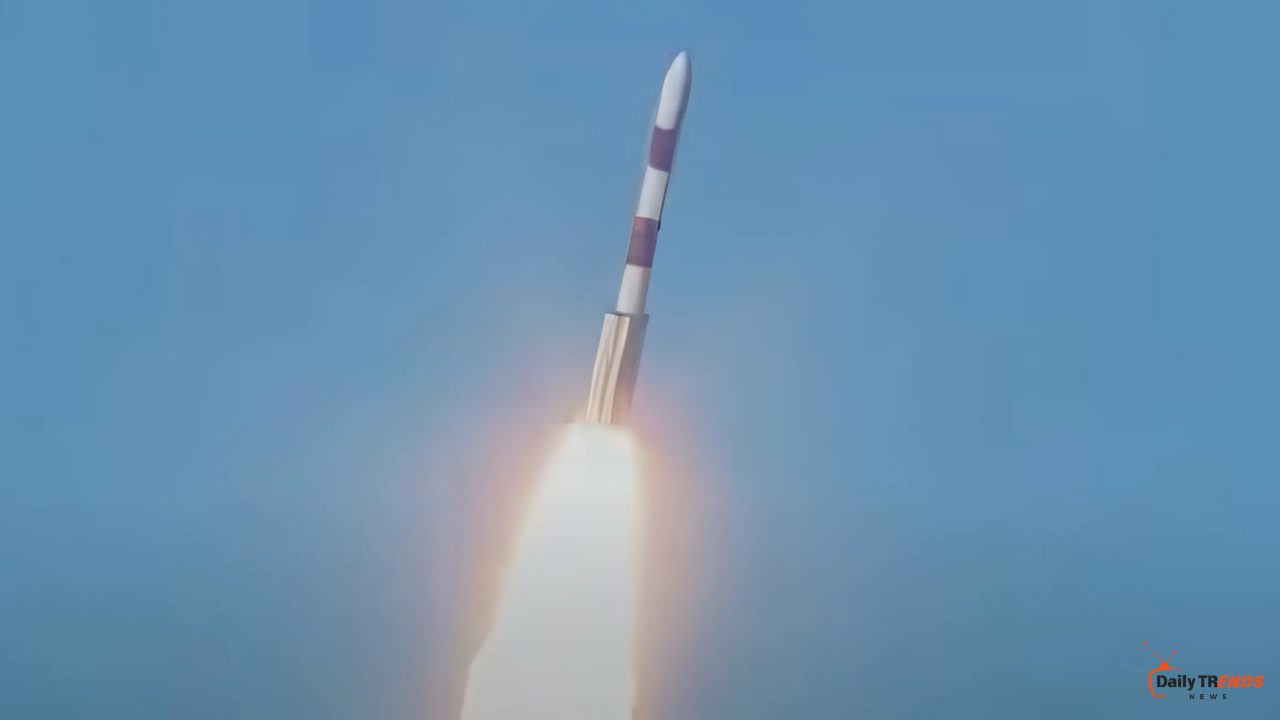
Sriharikota, May 18: ISRO’s 101st mission failed on Sunday when its PSLV-C61 rocket could not place the EOS-09 satellite in orbit. The rocket left the Satish Dhawan Space Centre at 5:59 a.m., and its first two stages worked as planned. However, a fault in the solid-fuel third stage stopped the rocket from reaching the right speed, so EOS-09 never made it to space.
The EOS-09 Satellite
EOS-09 is an advanced Earth-observation satellite that uses radar to gather images in any weather or lighting. At launch, it weighed 1,696 kg and carried a C-band Synthetic Aperture Radar (SAR) instrument, which delivers detailed pictures of the ground below.
As the newest member of ISRO’s RISAT series and repeat of EOS-04, EOS-09 operates in a Sun-synchronous polar orbit 529 km above Earth, inclined at 97.6°. This orbit lets it pass over the same locations consistently each day, completing a full circle every 95 minutes.
Designed for a five-year mission, the satellite carries enough propellant to maintain its precise orbit and, when its service ends, to execute a controlled re-entry—avoiding the creation of space debris and aligning with the space sustainability goals of ISRO .
EOS-09 is a useful satellite because it can work in all weather conditions. In farming, it helps spot early signs of crop problems. In forests, it checks for illegal tree cutting and monitors forest health. During floods, it quickly maps the affected areas. For national security, it watches borders clearly, even at night or through clouds. With its steady and detailed data, EOS-09 helps in many important areas, both for everyday use and for protecting the country.
Statement from ISRO Officials
At 6:33 AM, ISRO’s official X account shared that the nation’s 101st PSLV mission, carrying the EOS-09 Earth-observation satellite, had failed. According to the post, an unexpected anomaly in the rocket’s third stage caused the vehicle to lose thrust and fall short of the speed needed to enter orbit.
Today 101st launch was attempted, PSLV-C61 performance was normal till 2nd stage. Due to an observation in 3rd stage, the mission could not be accomplished.
— ISRO (@isro) May 18, 2025
ISRO went on to explain that EOS-09 was built on the well-tested RISAT-1 satellite “bus” (the core structure and systems), and that its key components—particularly the Synthetic Aperture Radar (SAR) sensor and the supporting platform electronics—were largely the same designs successfully flown on earlier radar-imaging satellites. By leveraging proven hardware, the agency had hoped to reduce risk and speed development.
Now, engineers have formed a failure-analysis committee to review flight data, pinpoint the root cause of the third-stage issue, and apply those lessons to future launches.
You may also like to read
2036 Olympic in India: Will the Nation Finally Host the Games?
Thank you for reading!